
The Non-Surgical Facelift Everyone's Asking About: What HIFU Really Does
Home
Services
Key Takeaways
- HIFU stands for High-Intensity Focused Ultrasound, and it works by delivering focused energy deep into the skin to stimulate collagen production.
- It's most commonly used to lift and tighten the jawline, neck, and overall facial firmness, without any incisions or downtime.
- Results build gradually over weeks as new collagen forms, rather than appearing instantly like a filler.
- A typical course involves two sessions, and results are generally described as natural looking rather than dramatic.
- It's not a replacement for a surgical facelift in cases of significant sagging, it's a meaningful option for earlier stage laxity.
"Non-surgical facelift" gets used loosely in the aesthetics world, and HIFU has become one of the most talked about treatments to carry that label. But the phrase alone doesn't explain much. Here's what's actually happening under the skin, and what to realistically expect.
How HIFU Actually Works
HIFU uses focused ultrasound energy that passes through the skin's surface without damaging it, and concentrates at a specific depth beneath. That focused energy heats the tissue at that layer, which triggers your body's natural collagen production response. Over the following weeks, that new collagen gradually tightens and lifts the treated area from within.
Where It Works Best
HIFU is most commonly used on the jawline, neck, and general facial firmness, areas where mild to moderate sagging has started to show but where surgery isn't the right conversation yet. It can also help soften the appearance of fine lines as skin tightens and firms.
What the Actual Session Looks Like
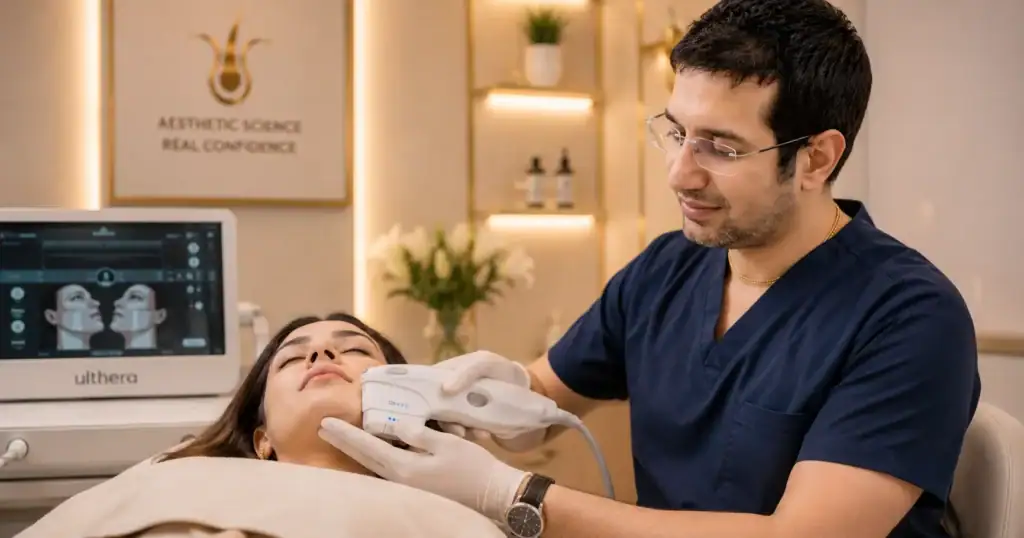
A HIFU session typically takes under an hour, and there's no cutting, no injections, and no real downtime. Most clients go back to their day immediately afterward. A course is usually built around two sessions, and results aren't meant to appear overnight, they build gradually as your body produces new collagen over the following weeks and months.
During the procedure, you may feel brief warmth or a light prickling sensation as the ultrasound energy reaches its target depth, this is a sign the treatment is working at the right layer, not a cause for concern. Mild redness immediately afterward is common and typically settles within a few hours.
HIFU Versus a Surgical Facelift
It's worth being direct about this: HIFU is not a replacement for surgery in every case. A surgical facelift physically repositions and removes excess tissue, which makes it the more appropriate option for significant, longstanding sagging. HIFU works by stimulating your own collagen response, which means the results are inherently more gradual and moderate. The honest way to think about it is as a preventive or early-intervention option, not a substitute for surgery once sagging has progressed significantly. Part of what we do in a consultation is being upfront about which category your skin actually falls into, rather than selling HIFU as a universal fix.
Aesthetic researchers have noted that focused ultrasound based treatments can stimulate deep collagen remodelling in ways that surface-level treatments generally cannot reach.
How Long Does It Actually Last?
Results from a HIFU course typically last several months before the natural aging process gradually catches back up. Because collagen production is a biological process and not an instant mechanical effect, the improvement tends to look subtle and natural rather than sudden, which is part of why it's become a popular option for people who want visible change without anyone asking "did you get work done."
Is It Right For You?
HIFU tends to work best for people noticing early to moderate skin laxity, rather than significant sagging that's been present for years. If your main concern is deep wrinkles rather than looseness, treatments like Botox or dermal fillers might be a more relevant starting point, and the two approaches are often combined depending on what your skin actually needs.
Common Questions We Get About HIFU
Is HIFU painful?
Most clients describe it as a warm, prickling sensation rather than sharp pain. Discomfort levels vary by individual and by area treated, and your specialist can adjust settings if a particular zone feels more sensitive.
How soon can I see results?
Initial mild tightening can be noticeable within a few weeks, but the fuller effect typically develops over two to three months as collagen production continues to build.
Is there any downtime at all?
Generally no significant downtime. Some clients experience mild redness or slight swelling for a few hours to a day, but most return to normal activities immediately after the session.
Can HIFU be combined with Botox or fillers?
Yes, and this is fairly common. HIFU addresses laxity and firmness, while Botox and fillers address wrinkles and volume loss separately. Many clients use a combination depending on what their skin needs across different concerns.
The honest answer to "is HIFU worth it" depends entirely on what your skin looks like right now, not on what worked for someone else's timeline. If you've been noticing early sagging and want a straightforward, surgery-free way to address it, book a consultation and we'll tell you plainly whether HIFU is the right starting point for you.