
Hair Transplant in Juhu
Surgery performed in-house by an oral and maxillofacial surgeon. Your own follicles, moved to where they are missing, with a hairline designed for your face and an honest graft count.
- Surgery, in-house
- Local anaesthetic
- Your own hair
- Grafts assessed
Moving follicles, not growing new ones
A hair transplant moves follicles from an area where hair grows densely — usually the back and sides of the scalp, the donor site — into the areas that have thinned or gone bald, the recipient site. Hair from the donor area is genetically resistant to the hormone that causes pattern baldness, so once moved, it keeps growing where it is placed.
That also defines the limits. A transplant redistributes the hair you have; it does not create more of it. Your donor area is finite, and how much coverage is achievable depends on how dense that donor supply is against how large an area needs filling. Anyone quoting a graft number before examining your scalp is making it up.
Design matters as much as technique. A hairline that sits too low or runs too straight will look wrong for the next forty years, however well the grafts take. It has to suit your face, your age and how your hair loss is likely to progress — which is a surgical judgement, and the reason this is done here by a surgeon rather than delegated to a technician.
Who it suits
- A receding hairlineThe most common reason people come in, and usually the most predictable to correct.
- A thinning crownTreatable, though the crown swallows grafts quickly because of the way hair swirls there.
- Stable hair lossLoss that has settled into a pattern rather than falling rapidly. Active, fast loss is treated medically first, or the transplant ends up surrounded by thinning hair.
- A good donor areaDense hair at the back and sides. This, more than anything, decides what is achievable.
- Eyebrows and beardThe same principle applied to gaps in eyebrows or patchy beard growth.
- ScarsHair restored into scarred areas of the scalp, assessed case by case.
Not suitable if your hair loss is still progressing rapidly, your donor area is too thin to supply the grafts needed, you have an uncontrolled condition such as diabetes, a bleeding disorder or an active scalp infection. Tell us about every medicine you take, especially blood thinners. Some people are better served by PRP, GFC or medical treatment first, and we will say so.
How it works
-
Assessment and planning
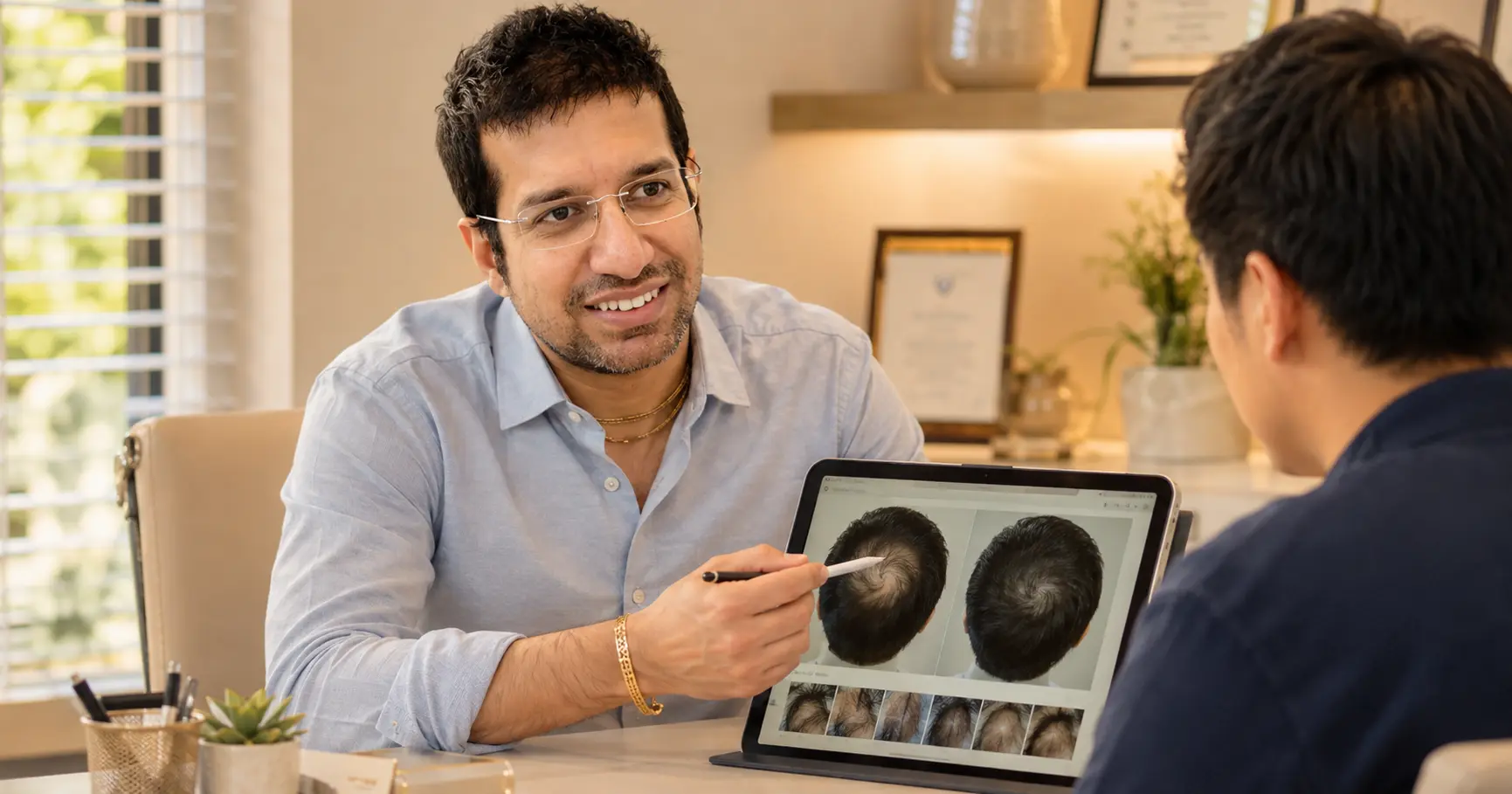
Dr. Khushal examines your scalp and donor density, discusses how your loss is likely to progress, and gives you a graft number based on what he sees. Blood tests are done before surgery.
-
Designing the hairline
The new hairline is drawn on and agreed with you before anything is done. This is the part to take your time over.
-
Anaesthesia
The scalp is numbed with local anaesthetic. You are awake throughout, and can talk, listen to something or watch a film.
-
Harvesting
Follicles are extracted from the donor area and kept in a preserving solution while they wait. This is the slow, careful part of the day.
-
Implanting
Sites are made in the recipient area at the angle and direction natural hair grows, and the grafts are placed one by one. Direction is what makes the result look like hair rather than a doll’s head.
-
Recovery and growth
You go home the same day with written instructions and medication. The transplanted shafts shed within the first few weeks — expected, and not a failure — with new growth generally starting around three to four months and the full result appearing over nine to twelve months. Large areas may need more than one sitting.
Post-operative care
You are given written instructions and medication on the day. In general:
- Take the medicines prescribed, including antibiotics and painkillers, exactly as directed.
- Sleep with your head elevated for the first few nights, and avoid any pressure on the grafted area.
- Do not touch, scratch or pick at the grafts or the scabs that form.
- Wash your hair only as and when instructed, gently, in the way you are shown at the clinic.
- Swelling of the forehead in the first few days is common and settles.
- No gym, swimming, steam, sauna or heavy lifting for at least two weeks.
- No smoking or alcohol around the procedure — both interfere with healing.
- No hair colour, chemical treatment or trimmers on the grafted area until you are cleared.
- Keep the scalp out of direct sun, and wear whatever head covering the clinic approves.
- Attend your follow-up appointments, and call the clinic for fever, spreading redness, pus or bleeding that will not stop.
One thing to be clear about: transplanted hair stays, but the native hair around it can keep thinning. That is why some people need medical treatment alongside surgery to hold what they already have, and why a second sitting is sometimes planned years later. We would rather set that out now than have you feel misled in five years.
Book a transplant consultation
Bring any blood reports and, if you have them, photographs of your hair from a few years ago. You will leave knowing whether surgery is the right step and roughly how many grafts it would take.
- Mon–Sat 9:30 AM to 8:00 PM. Sunday by appointment.
- +91 98239 00884 / +91 86690 65851
- WhatsApp +91 98239 00884
- mkaestheticsjuhu@gmail.com
- Flat No. 8, First Floor, Sukh Shanti Building, above Dhanani Jewellers, JVPD Scheme, Juhu, N S Road Number 8, Vile Parle West, Mumbai 400049
Request an appointment
Hair transplant FAQs
Does it hurt?
The scalp is numbed with local anaesthetic, so the procedure itself is not painful. The anaesthetic injections are the uncomfortable part. Afterwards you can expect soreness and tightness, managed with the painkillers you are given.
How long does it take?
It is a full-day procedure, and the length depends on the number of grafts. You go home the same day. Large areas are sometimes planned across more than one sitting.
How many grafts will I need?
That can only be answered after your scalp and donor area have been examined. The number depends on the size of the area and how dense your donor supply is. A figure quoted over the phone is a sales number, not a clinical one.
When will I see results?
The transplanted shafts shed within the first few weeks, which is expected. New growth generally begins around three to four months, and the full result appears over nine to twelve months. This is a treatment measured in seasons.
Will it look natural?
That depends on hairline design and the angle each graft is placed at, which is exactly why a surgeon does it. A well-designed hairline is irregular and soft at the front, and it should suit your age and face rather than the one you had at twenty.
Is transplanted hair permanent?
The transplanted follicles keep growing, because donor hair resists the hormone that causes pattern baldness. Your surrounding native hair can still thin, though, which is why medical treatment often runs alongside surgery.
Will there be scars?
The donor area has tiny extraction points that heal and are hidden by surrounding hair at normal length. Very short haircuts can make them faintly visible. Healing varies between people, and a keloid tendency is worth telling us about.
When can I go back to work?
Many people return within a few days, depending on the work and how visible the area is. Swelling and scabbing are noticeable in the first week, so plan around anything where you would rather not explain it.
Should I try PRP or GFC first?
If your hair is thinning rather than gone, often yes. Injections strengthen follicles that are still alive, while surgery is for areas where they are not. The consultation is where that line gets drawn for your scalp.
Related treatments
- Hair Loss TreatmentPRP and GFC therapy, for thinning hair where follicles are still alive.
- IV DripsThe Lustrous Hair drip, with biotin, zinc and multivitamins.
- Laser Hair ReductionThe opposite problem, on the face and body.
- Skin BoostersInjectable hydration for skin quality, including PDRN and exosomes.