
Hair Loss Treatment in Juhu
PRP and GFC therapy for thinning hair, using growth factors from your own blood. Assessed by a doctor first, because not every kind of hair loss responds to injections.
- 6 sessions
- PRP or GFC
- Your own blood
- No surgery
Feeding the follicles you still have
A small amount of your blood is drawn and spun in a centrifuge to concentrate the platelets and growth factors it contains. That concentrate is then injected into the scalp, where those growth factors stimulate follicles that have weakened and shrunk.
The key word is stimulate. PRP and GFC work on follicles that are still alive but underperforming — the thinning crown, the widening parting, the hairline that has become see-through. They cannot bring back a follicle that has died, which is why a bald patch needs a transplant rather than injections, and why the first appointment is an assessment rather than a treatment.
Hair loss also has causes that no injection fixes: thyroid problems, iron or vitamin deficiency, PCOS, recent illness, crash dieting, stress. Dr. Khushal will look for those first. Treating the scalp while ignoring the reason underneath is how people spend a year on sessions and see nothing.
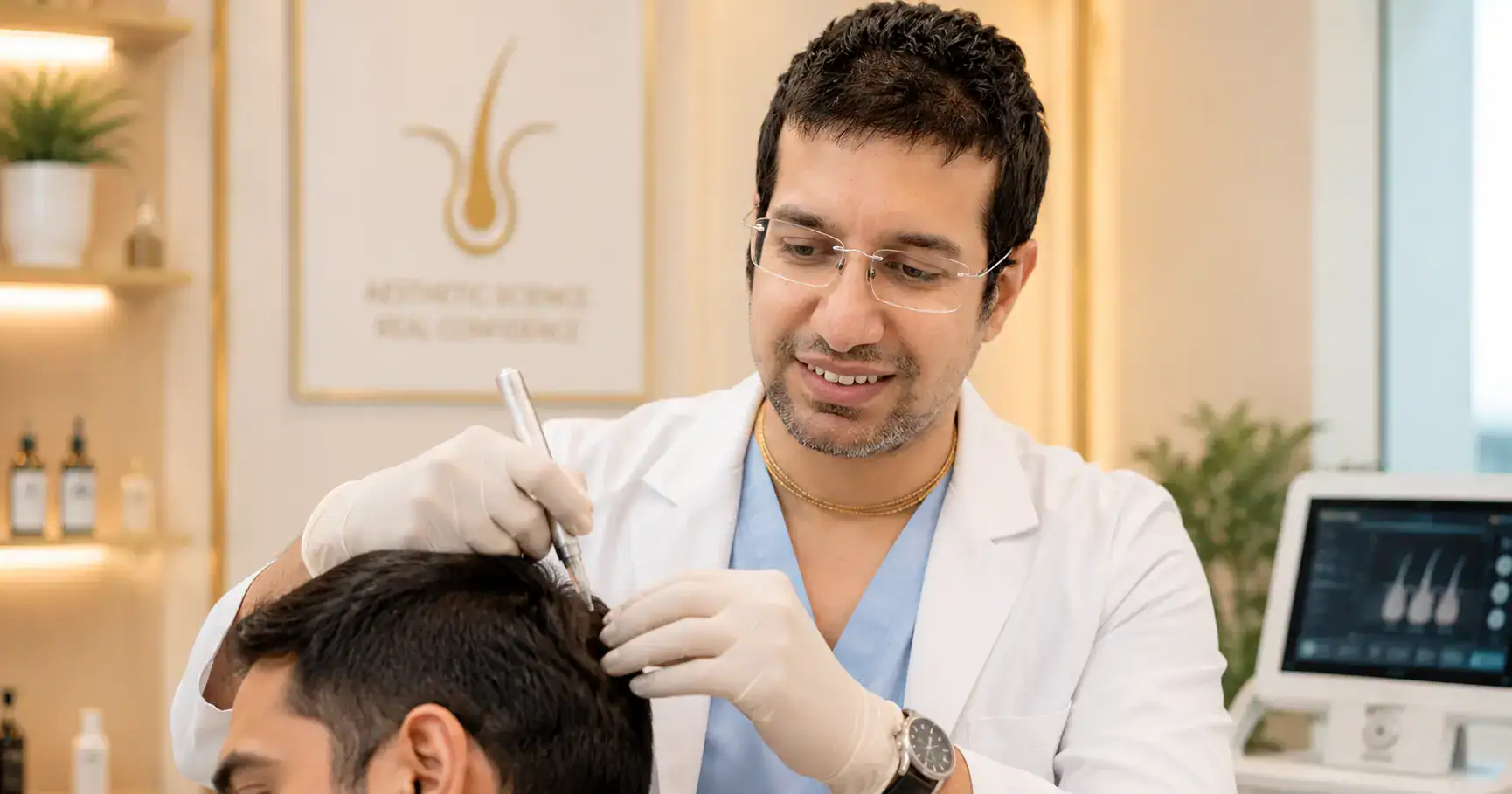
PRP and GFC
- PRP therapyPlatelet-rich plasma, prepared from your own blood on the day and injected across the thinning areas. The established option, given as a course of six sessions.
- GFC therapyGrowth Factor Concentrate, processed to yield a higher concentration of specific growth factors than PRP. That may stimulate follicles more strongly and show results sooner. Also a course of six.
- Which one suits youDecided at the consultation, based on how much thinning there is, how fast it has progressed and what you have already tried.
- What goes with itInjections work best alongside the basics — correcting any deficiency, treating the underlying cause, and whatever topical or oral treatment your scalp needs.
Not suitable if you have a bleeding or platelet disorder, an active scalp infection, or are on blood thinners, and generally not during pregnancy. Areas that are completely bald will not respond, because there are no follicles left to stimulate. Tell us about every medicine and supplement you take, along with any recent illness.
How it works
-
Assessment
Dr. Khushal examines your scalp and hair pattern, asks about family history, recent illness, diet and medication, and may ask for blood tests before starting anything.
-
Blood draw
A small quantity of blood is taken from your arm, exactly as it would be for a routine test.
-
Processing
The sample is spun in a centrifuge to separate and concentrate the platelets and growth factors. This takes a few minutes while you wait.
-
Numbing
The scalp is cleaned and numbed so the injections are comfortable.
-
Injections
The concentrate is injected across the thinning areas in a grid of small, shallow injections. You will feel pressure and brief stings rather than pain.
-
The course
A course is six sessions, spaced out over several months. Hair fall usually settles before new growth appears, and the visible change comes gradually rather than session by session.
Post-care instructions
The clinic gives you written instructions on the day. In general:
- Leave the scalp alone for the rest of the day — no washing, no oiling, no products.
- Wash your hair with a mild shampoo from the next day, gently, with lukewarm water.
- No hair colour, chemical straightening or keratin treatment for about a week.
- Skip the gym, steam, sauna and swimming for 24 to 48 hours.
- Avoid direct sun on the scalp for a day or two, and wear a loose cap if you must be out.
- Tenderness, mild swelling or a heavy feeling for a day is normal.
- Anything unusual — spreading redness, pus, fever, lasting pain — call the clinic.
What to expect: reduced hair fall usually comes first, often within the first couple of months. New growth is slower and builds across the course. Hair grows on its own timetable, so this is a treatment measured in months, and maintenance sessions are usually needed afterwards to hold what you have gained.
Book a hair assessment
Bring any recent blood reports if you have them. We will tell you what is driving your hair loss and whether PRP or GFC is likely to help.
- Mon–Sat 9:30 AM to 8:00 PM. Sunday by appointment.
- +91 98239 00884 / +91 86690 65851
- WhatsApp +91 98239 00884
- mkaestheticsjuhu@gmail.com
- Flat No. 8, First Floor, Sukh Shanti Building, above Dhanani Jewellers, JVPD Scheme, Juhu, N S Road Number 8, Vile Parle West, Mumbai 400049
Request an appointment
Hair loss treatment FAQs
Does it hurt?
The scalp is numbed first, so the injections feel like pressure and brief stings rather than pain. The blood draw is the same as any routine test. Tenderness for a day afterwards is common.
What is the difference between PRP and GFC?
Both use your own blood. GFC is processed to yield a higher concentration of specific growth factors than PRP, which may stimulate follicles more strongly and produce faster results. PRP is the longer-established option. We will recommend one after examining your scalp.
How many sessions will I need?
A course is six sessions for both PRP and GFC, spaced over several months. Most people then need maintenance sessions to hold the result, because the underlying tendency to thin does not go away.
How soon will I see results?
Hair fall usually reduces first, often within the first couple of months. New growth takes longer and builds across the course. Nothing here works in weeks, and anyone promising that is not being straight with you.
Will it work on a bald patch?
No. These treatments stimulate follicles that are alive but weak. Where the scalp is completely bald, the follicles are gone and a hair transplant is the option that applies.
Is it safe?
The material injected is derived from your own blood, so there is no question of rejection or an allergic reaction to a foreign substance. The usual risks are those of any injection — tenderness, mild swelling, small bruises, and a low risk of infection.
Do I need blood tests first?
Often, yes. Thyroid problems, low iron, vitamin deficiency and hormonal conditions such as PCOS all cause hair loss, and treating the scalp without correcting those wastes your course.
Is this the same as a hair transplant?
No. A transplant moves follicles from the back of the scalp into bald areas surgically. PRP and GFC are injections that strengthen existing follicles. Some people have both, with injections used to support the transplanted and surrounding hair.
Related treatments
- Hair TransplantSurgical restoration for areas where the follicles are gone.
- IV DripsThe Lustrous Hair drip, with biotin, zinc and multivitamins.
- Vampire Facial (PRP)The same platelet-rich plasma, used on the face instead of the scalp.
- Skin BoostersInjectable hydration, including PDRN and exosome boosters.